


The Lucas Museum of Narrative Art Is Finally Ready to Tell Its Story
Published Sep 12, 2026
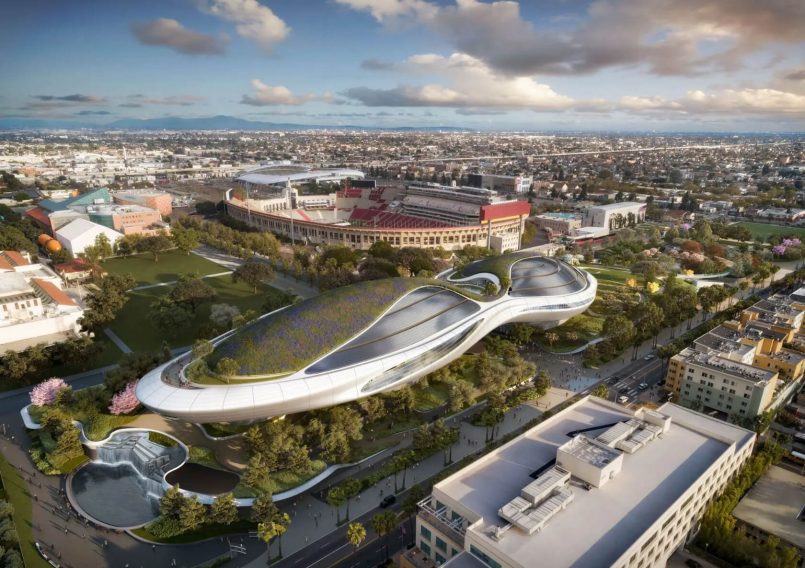
Set within Exposition Park in Los Angeles, the Lucas Museum of Narrative Art is the long-awaited project founded by filmmaker George Lucas and his wife, businesswoman Mellody Hobson.
Designed by Ma Yansong of MAD Architects, with Michael Siegel of Stantec as executive architect and a landscape by Mia Lehrer of Studio-MLA, the museum opens to the public on September 22.
And it’s difficult to imagine a more appropriate building for a museum devoted to storytelling.
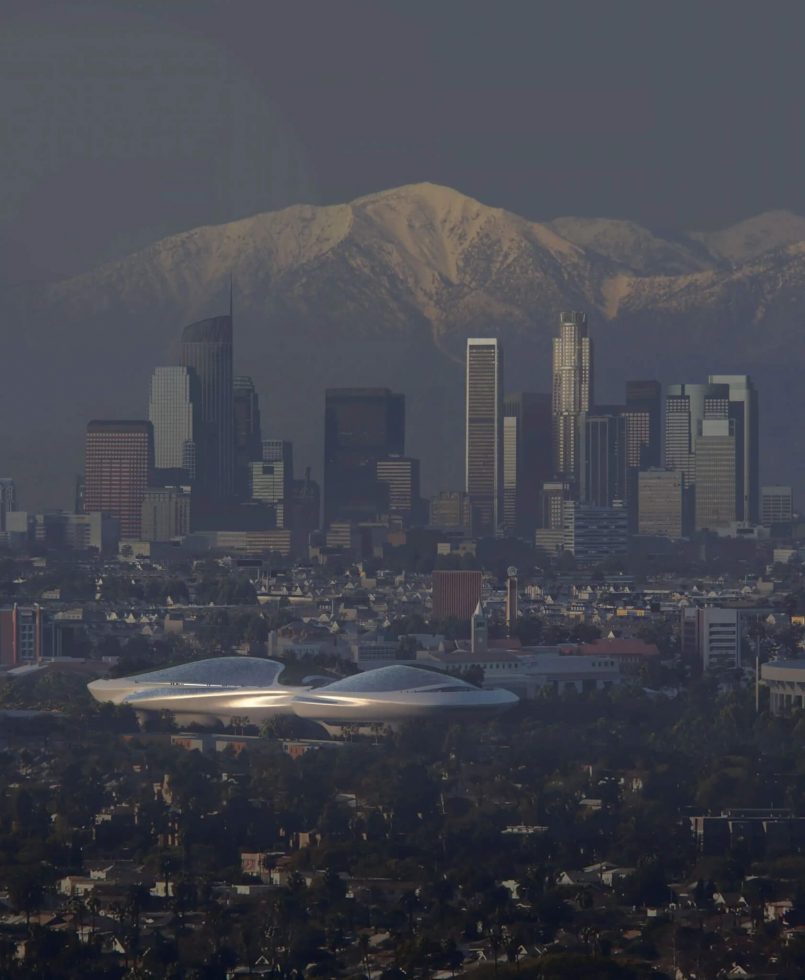
Otherworldly Architecture
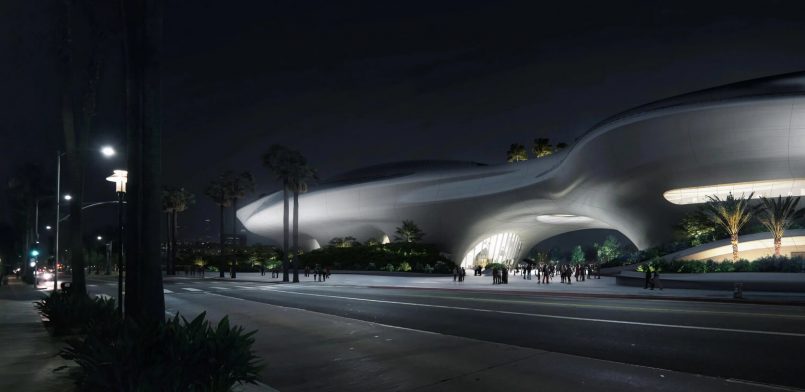
At first glance, the Lucas Museum looks almost extraterrestrial. Its enormous white form appears to hover above the landscape, with sweeping curves, dramatic cantilevers and very few of the right angles normally associated with a conventional cultural institution.
The five-story, 300,000-square-foot building is wrapped in more than 1,500 individually shaped fiberglass-reinforced polymer panels. Together, they create the building’s sinuous, biomorphic skin, giving it the appearance of a gigantic object suspended just above the ground.
MAD founder Ma Yansong conceived the architecture as something closer to a canopy or a giant shade tree than a traditional museum. The structure rises from the landscape, creating a covered public space beneath it rather than presenting visitors with an imposing architectural wall.
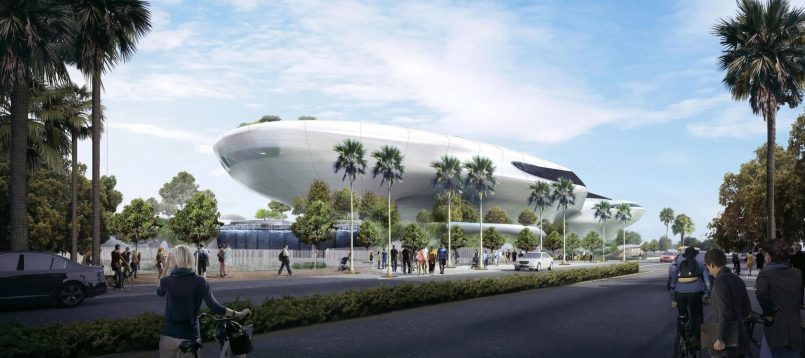
At the entrance, an elliptical oculus opens the covered plaza to the sky. Inside, the same language continues through rounded corridors, vaulted spaces and curved elevator cabins. Even the smaller details follow the organic nature of the architecture.
The result is a building that feels deliberately cinematic. Rather than leading visitors through a formal entrance and up a grand staircase, the museum reveals itself gradually. Spaces curve, reveal and disappear, creating the sense that something is always waiting around the next corner.
Storytelling Without Boundaries
“Stories are mythology, and when illustrated, they help humans understand the mysteries of life.”
George Lucas
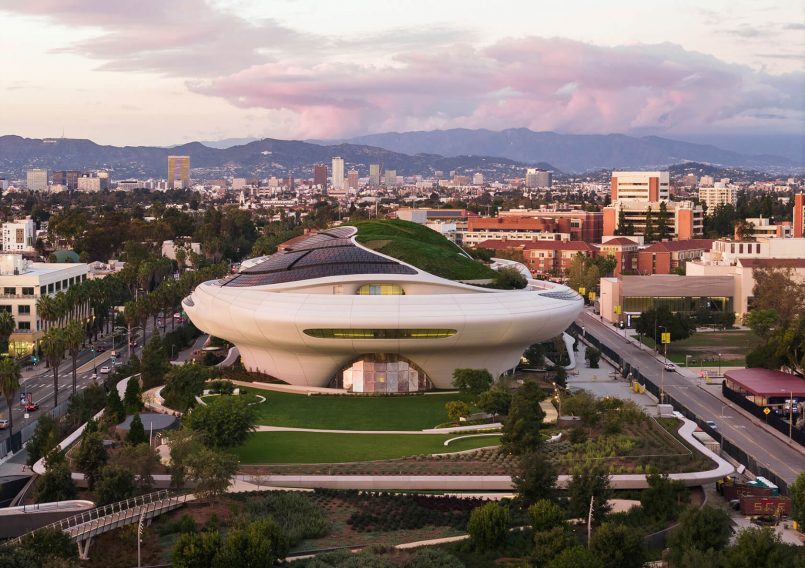
The museum’s architecture would be spectacular enough on its own, but the collection is just as unconventional.
The Lucas Museum is dedicated to narrative art, broadly defined as visual storytelling. Its collection moves across centuries and disciplines, bringing together painting, illustration, photography, comics, sculpture and cinematic art.
The museum seeks to explore how stories connect people and capture the human experience, built on the belief that illustrated storytelling is a universal language.
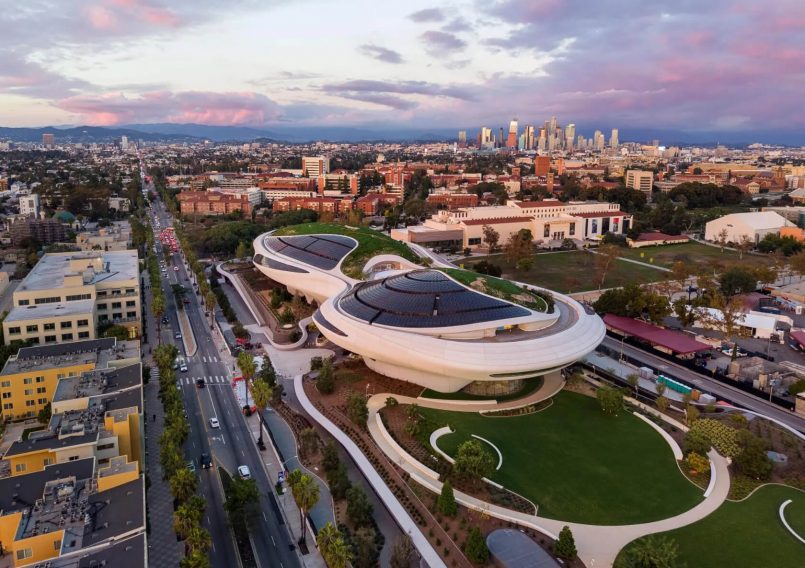
“This is a museum of the people’s art. The images are illustrations of beliefs we live with every day. For that reason, this art belongs to everyone. Our hope is that as people move through the galleries, they will see themselves, and their humanity, reflected back.”
Mellody Hobson
The founders’ collection brings together an eclectic mix of artists, including Frida Kahlo, Norman Rockwell, Beatrix Potter, Judy Baca, Maxfield Parrish and Kadir Nelson, alongside comic artists such as Jack Kirby, Winsor McCay, Frank Frazetta, Alison Bechdel, Chris Ware and R. Crumb.
Rather than separating fine art from popular culture, the museum asks what happens when they are considered part of the same larger tradition: humans using images to explain themselves, their communities and the world around them.
It is a deliberately democratic approach to art history. A Renaissance painting can sit conceptually alongside a comic book, while a Norman Rockwell illustration can share the conversation with a cinematic artifact.
Its inaugural exhibitions will feature more than 1,200 objects across more than 30 galleries. The works span ancient sculpture, Renaissance painting, photography, comics and modern cinema, with exhibitions organized around themes such as love, family, community, play, work, sports, childhood and adventure.
Beyond the Galleries
Alongside its galleries, the building contains two cinematic theaters, a library, learning spaces, retail and fine dining, including a rooftop restaurant with views across Los Angeles.
The museum will also showcase cinematic artifacts such as movie posters and screen documentaries featuring artists and filmmakers. Together, these elements reinforce the museum’s larger ambition: to create a cultural destination where art, film, education, food and public space come together.
The goal is to blur the boundaries between high culture and everyday experience, inviting visitors to engage with storytelling in many different forms.
The journey is less like moving through a conventional museum and more like moving through a sequence of scenes. For a museum about storytelling, it feels exactly right.
Images: MAD Architects and photographer Patrick Price for Studio-LMA.








More
articles
Inspiration
in your inbox
Amazing art & design, never any spam.
We care about protecting your data. Please refer to our Privacy Policy for more.
- Advertising
- Architecture
- Art
- Branding
- Fashion & Beauty
- Gaming
- Graphic Design
- Illustration
- Industrial Design
- Interior Design
- Logo Design
- Packaging Design
- Photography
- Pop Culture
- Print Design
- Product Design
- Technology
- Typography
- UX & UI Design
- Vehicle Design
- Video & Motion
© 2026 Inspiration Grid, all rights reserved. Some of our posts may contain affiliate links to partner brands. We earn a small commission if you click the link and make a purchase. There is no extra cost to you, so it’s just a nice way to help support the site. All images, videos, and other content posted on the site is attributed to their creators and original sources. If you see something wrong here or you would like to have it removed, please contact us.